Local Elections, Local Mood.
In 2026, understanding public and political mood is a prerequisite for effective consultation and community engagement on infrastructure.
The 2026 local government elections are just over a week away. And they’re landing in a period of increasingly turbulent politics, where “the public mood” can swing faster than the delivery timescales of transport, energy and regeneration programmes.
For those of us working on nationally significant infrastructure and place-based change, local election results aren’t just another “local news story”. Instead, they indicate the scale of challenge ahead when constructively communicating with the public, stakeholders and politicians on the rationale, details and benefits of a scheme, all while navigating scrutiny, and meeting project timelines and budgets, to try to deliver change.
In my January blog, I argued that in a polarised age, consultation can’t pretend to sit in a neutral, technically focussed space. It needs clarity about the values behind a proposal, because politics is increasingly shaped by values: not process.
So, with that as the foundation, what do the 2026 local government election polls tell us about where consultation, community and stakeholder engagement is heading next?
The centre has been shrinking, meaning multi-party governance of councils has been on the rise
Over the past decade, we’ve seen growing momentum for parties and groups perceived to sit to the right or left of the traditional centre ground, alongside a rise in independents and localist groups. That trend has consequences that go beyond seat tallies.
First, it makes majorities harder to win.
The House of Commons Library reported that the 2025 English local elections produced the lowest ever average winner’s vote share at 40.7%. This is a marker of deepening fragmentation among the electorate.
Second, it increases the number of councils under “no overall control” (NOC).
Using the latest seat totals across all English council types (counties, unitaries, metropolitan boroughs, London councils and districts), 136 of England’s 317 councils currently have no single party with an overall majority – or around 43% of them.
That’s a dramatic shift from 2015, when Open Council Data’s 2015 snapshot shows the England NOC figure at 50 – or less than 16%.
And if we focus on the councils most relevant to major infrastructure and related policy delivery - counties, unitaries, metropolitan boroughs and London authorities - the same dataset indicates that 48 of 153 are currently NOC (around 31%).

Why this matters for consultation
NOC governance typically means a more complex mix of competing political priorities. It brings a greater likelihood that “what the council thinks” is not one consistent, clear position; it must be continually re-confirmed. For those delivering consultation and engagement, the political environment you’re working within can be multi-voiced, contested, and fast-changing, requiring a specific focus to successfully navigate to a desired destination.
2026 is set to fast-track this process: all-out elections and fragile majorities
The 2026 locals are unusually significant in terms of the potential for major shifts in the political balance and leadership. They take place on Thursday 7 May 2026 across 134 of England’s 317 councils.
All-outs
All-out elections — which see votes cast to elect to every councillor position on a council — change the dynamics of an election because they allow public mood shifts to translate into sudden changes in political control. In other words, a council that has a strong majority for one party, can see this position reversed if the public mood has sufficiently shifted in the past year or two. This is in contrast to the incremental change that we see within councils which typically host elections every three years in four – known as voting in thirds because just one third of councillors stand for re-election in any one year under normal electoral circumstances.
Boundary changes have prompted a number of all-out elections in councils across England in 2026, not least in some of the big metropolitan borough councils, which typically vote in thirds. In addition, several other councils have all-out elections this year for other reasons. Some of these are scheduled elections for councils that typically elect all their councillors every four years anyway. Others are for new councils that are just being created as part of local government re-organisation. In total (excluding district councils), 60 of England’s 153 London borough, county, unitary and metropolitan borough councils have all-out elections of one form or another in 2026. That brings an unusually large scope for change in political control at many councils at precisely the point at which polarisation in the political debate is now prominent, and so the scope for change is high.
Thin majorities
Irrespective of all-out elections, a significant number of councils are sitting on thin majorities. Based on the latest seat totals, there are dozens of authorities where the ruling majority administration is only a handful of seats above (or even at) the majority threshold needed to form a single party administration. This means that a modest swing in voting behaviour away from the ruling party can push them into NOC.
When we take the prospect of all-out elections and thin majorities together, it would be remarkable if the number of councils in NOC didn’t rise further after May.
Polls point to a multi-party pattern — and more fragmented political mandates to govern
National polling is also consistent with this story.
A YouGov Westminster voting intention poll in mid‑April put Reform on 24%, Conservatives on 19%, Greens on 18%, Labour on 17%, and the Lib Dems on 13% — a remarkably even split across the five parties.
Projection models that translate this into outcomes at the local elections suggest significant gains in the number of councillors representing Reform, and to a slightly lesser extent, the Greens, with sizeable losses for Labour and the Conservatives, and smaller gains for the Lib Dems — exactly the kind of multi-directional movement that increases the probability of NOC and coalition-style governance.
Of course, local elections are hyper-local, independents matter, and turnout patterns vary but the direction of travel is clear: more volatility, more competition, and more complex governance outcomes.
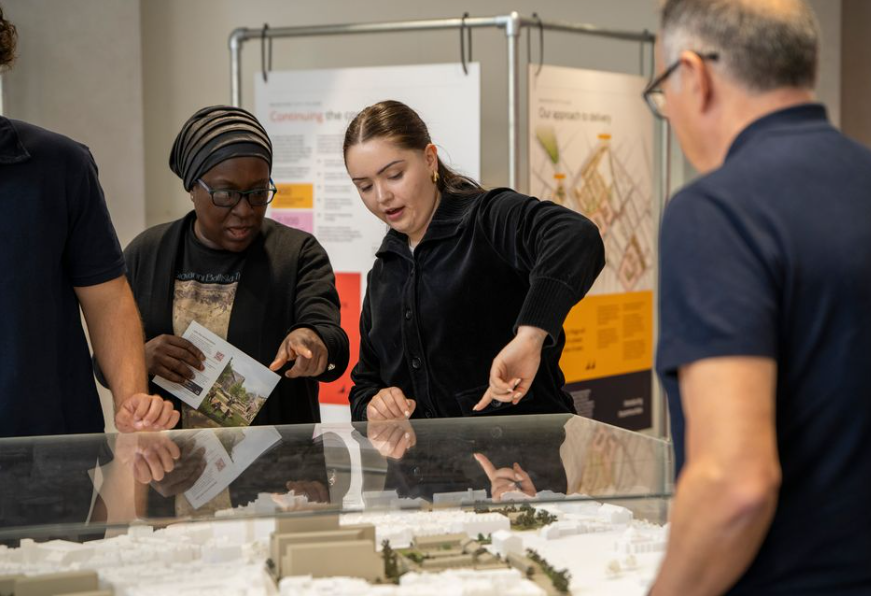
Community engagement event. Photo credit: Heather Magner | Northern Exposure Photography & Videos
What this means for consultation, stakeholder and community engagement, and construction comms
For clients delivering transport, energy and regeneration schemes, the political weather matters because it directly shapes the permission space needed for projects and policies to be proposed, designed, consulted on, approved and delivered. In a more fragmented governance environment, the “rules of engagement” can shift.
Here are four practical shifts we’re increasingly advising clients to make themselves when consulting or engaging on schemes:
1) Treat political context as a consultation/engagement strategy design input, not an afterthought
NOC and tight majorities mean stakeholder mapping can’t be static. It needs to anticipate shifting coalitions, committee dynamics, and political balance. There is an increasing need to secure cross-party support to stabilise the opportunity to design, develop and deliver projects and policies.
2) Build values-led narratives that are honest about trade-offs
If the centre is hollowing out, consensus language often reads as evasive. Clear purpose, rooted in community benefit and based on values, is more robust than bland neutrality, or sitting on the fence.
3) Prepare for challenge and scrutiny as default
In fractured systems, scrutiny can come from multiple angles at once. Consultation and engagement planning need resilience: a rapid capability to respond confidently, comprised of consistent, agreed messaging, a solid position platform and the ability to deploy responses quickly via a credible local spokesperson.
4) Make engagement a continuous relationship wherever possible, not a campaign phase
All-out elections and political churn mean key decision-makers can change quickly. Programmes that maintain dialogue (not just formal consultation moments) are better positioned to adapt without losing trust.
If May’s results accelerate the rise of NOC councils — or even dramatic shifts in overall political control — the organisations that succeed will be those that treat political intelligence, stakeholder insight and engagement strategy as core delivery disciplines, not bolt-ons or nice-to-haves.
By Leigh Bramall, Director for Transport and Sustainability at Counter Context.