What turns a long-term vision into a credible investment proposition?
The focus should be on telling a compelling story that is informed by the people, businesses, stakeholders and communities who are part of it.
Following on from UKREiiF, we reflect on how a project we were proud to support – Hull's City Centre Vision – is helping to unlock investment across this great maritime city. Through extensive stakeholder engagement and consultation, the Vision was shaped by local insight as well as technical expertise, creating a stronger, more deliverable framework for the city's future.
As part of a multidisciplinary team led by Planit, and including Deloitte, ShedKM, Civic Engineers and Greengage, Counter Context worked throughout 2024 and 2025 to support the delivery of this ambitious project to develop a 20-year plan for Hull that reflects the city’s pride, ambition and drive.
In the past, we’ve seen regeneration plans stall because ambition is spread across disconnected projects competing for funding, political attention and market confidence. Hull's City Centre Vision sought to tackle this problem. Rather than presenting regeneration as a collection of individual investment opportunities, it provides a clear long-term framework that connects opportunities into a single, investable, story. Crucially, this story was developed alongside the people living it. Through early and regular engagement, ensuring Hull’s community was involved in the formulation of the vision from day one, we were able to harness the city’s pride, ambition and strong local identity and deliver a vision that truly reflects local priorities.
For Hull, this is particularly important. Despite being awarded UK City of Culture in 2017, Hull has been overlooked by many of the national investment programmes of the past decade and, prior to 2020, struggled to drive major regeneration in the same way some other cities were able to. Recent changes to the way national funding is allocated have provided Hull with an opportunity to strengthen its appeal to both public and private investors, but until now, the city lacked a unified strategy for how that investment would be directed. The City Centre Vision turns them into a practical investment proposition, showing how coordinated regeneration can unlock long-term growth.
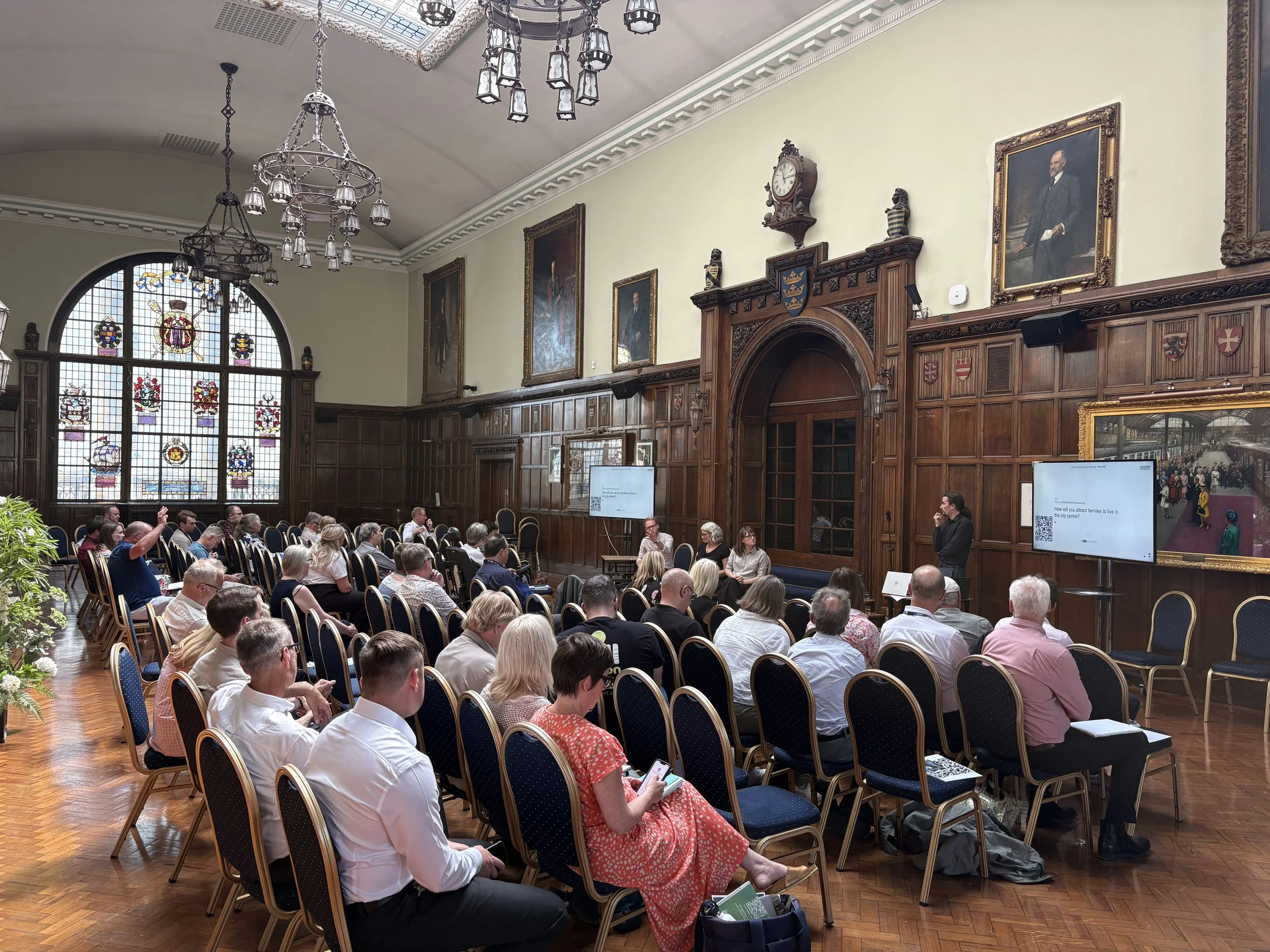
Across four phases of public consultation, we worked directly with local stakeholders to test assumptions, identify priorities and ultimately create a vision for Hull’s city centre that puts local priorities at the heart of the city’s regeneration ambitions.
Whose vision is it anyway?
When the team first sat down to kick off the City Centre Vision programme, we asked ourselves the question: what (and who) is a City Vision for?
A document like this needs to perform several functions. It needs to define the city’s ambitions in a way that attracts investors, builds confidence among locals, provides tangible and measurable goals, and satisfies Whitehall that the city is a good place to spend taxpayers’ money.
A key goal of any city vision is to make investment easier to understand. It gives developers, funders and partners confidence that projects are connected, priorities are clear, and regeneration is being delivered with purpose, planning and foresight rather than simply reacting to individual market opportunities.
We knew, therefore, that to be successful, the vision must be more than a list of potential development sites; it must tell the story of Hull in a way that shows the city is ready to meet the challenges it faces.
Bringing together the perspectives of residents, businesses, landowners, public sector partners and other stakeholders helped us challenge assumptions, identify hidden opportunities and build broader consensus around the city’s core objectives.
Catalysts for confidence
Another important element of the team’s approach to developing the Vision was the commitment to demonstrating how short-term investments would support the city’s long-term goals. As well as plans leading up to 2045, the Hull City Centre Vision contains a list of ‘catalyst projects’ - developments with the potential to come forward in the next 5 years, whose effects would also support the city’s 20-year ambitions.
East Bank Urban Village is the clearest example of the vision moving quickly from strategy to delivery. Delivered by Hull City Council in partnership with ECF, the development will transform a largely vacant brownfield site east of the River Hull into a new residential neighbourhood of up to 850 homes, alongside commercial space, new public realm, improved walking and cycling routes, restored riverside access and the reuse of heritage assets.
East Bank reconnects the city with its waterfront, expands city centre living and demonstrates how regeneration can create an attractive, mixed-use neighbourhood. East Bank offers something investors value highly: visible progress backed by long-term commitment.
Beyond Hull: Why does any of this matter?
Vision documents do not regenerate places on their own. Their value lies in reducing uncertainty, aligning public and private investment and providing confidence that projects are part of a coordinated long-term strategy. To do that effectively, they must be:
evidence-based,
locally supported,
and outcome-driven.
A list of brownfield sites does nothing to tell investors why they should invest here, nor does it help residents and taxpayers understand the strategic and economic direction their city is headed in. On the other hand, a vision document that tells a city’s story, articulates its ambition and clearly communicates what success will look like for those who live and work there, can build confidence and excitement among a wide range of stakeholders by providing a single set of well-defined objectives to rally behind.
In today's economic climate, where viability, inflation and delivery risk continue to shape investment decisions, this kind of clarity is increasingly what makes the difference between successful long-term planning and stalled regeneration.
Hull also demonstrates that successful investment propositions are about more than financial returns. They are stories themselves, explaining how growth will improve everyday life while respecting local identity, strengthening communities and creating better environments for people to live, work and spend time. By linking housing, culture, infrastructure, public realm and climate resilience, the City Centre Vision presents regeneration as a whole-place proposition rather than a collection of development sites.
Masterplanning requires Support. Support requires storytelling.
The old sales adage that “people buy from people” is no less true in the world of development and commercial real estate, but it also doesn’t stop with sales teams. And there are rarely better salespeople for a place than its residents, whose community pride and insight add an important human dimension to a place’s identity.
By working closely with stakeholders to develop a human-centric narrative which runs throughout the document, Hull's City Centre Vision has created a framework that gives investors confidence, helps partners align around shared priorities and provides a clear route from strategy to delivery.
For Hull, the challenge now is to sustain that momentum. For other places, the message is equally clear: masterplanning and community engagement is not the soft side of regeneration. When it is evidence-led, place-specific and tied to delivery, it becomes one of the most powerful tools a city has for attracting investment and creating lasting change.
By John Prendergast, Account Manager in Property and Regeneration at Counter Context.
At Counter Context, our Property and Regeneration team has a wealth of experience in building stakeholder trust and support across a range of built environment projects. Have a conversation with one of our experts today.